
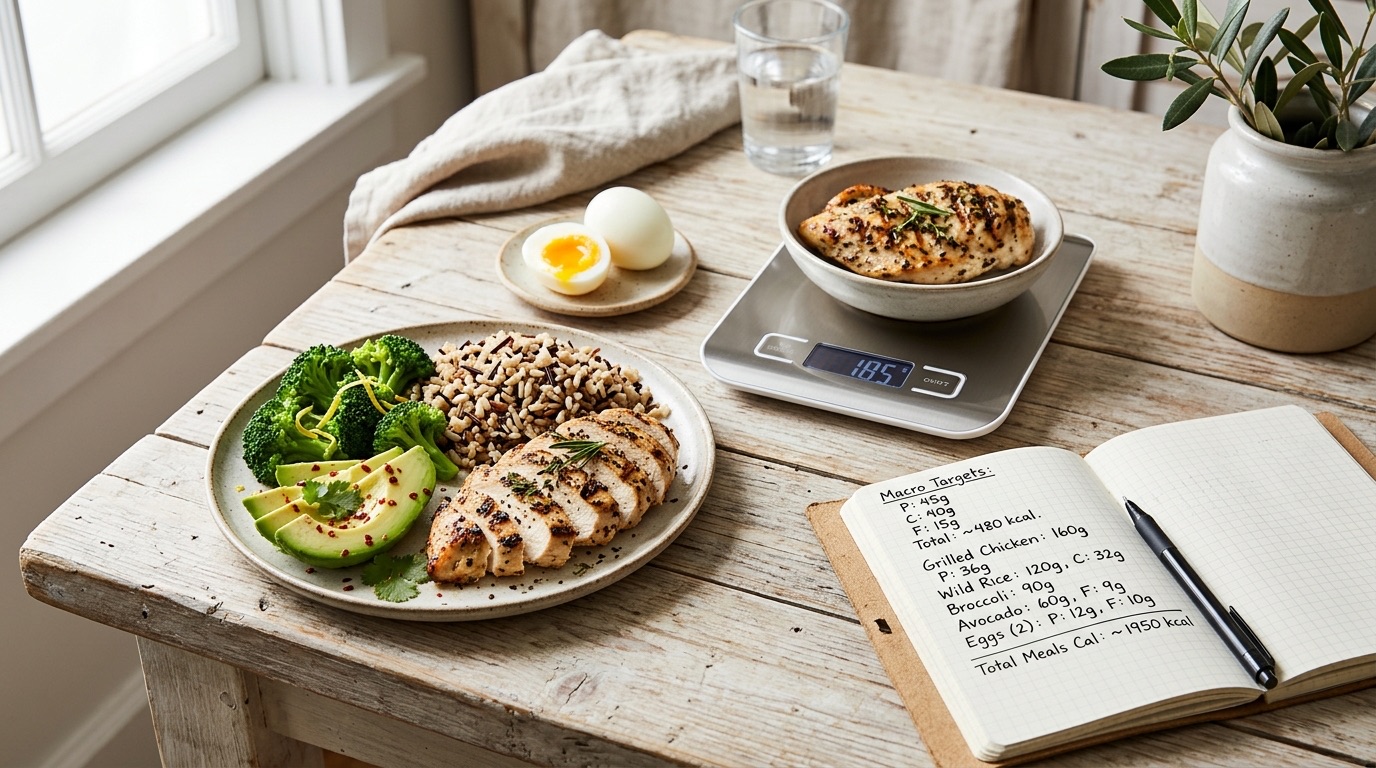
If you've searched this question before, you've probably seen wildly different answers — some people insist you need to eat 4,000+ calories a day to grow, others say a tiny surplus is enough. The honest answer sits closer to the second camp, and it's simpler than most of what you'll find online. Here's how to actually figure out your numbers and what to expect once you're eating in a surplus.
Start With Your Maintenance Calories
Before you can eat "extra" for muscle growth, you need to know what "normal" looks like for you. This is your maintenance calories, or TDEE (total daily energy expenditure) — the amount you'd eat to keep your weight roughly stable.
You can estimate this a few ways:
- Quick formula: bodyweight (kg) × 30-33 gives a rough daily maintenance estimate for a moderately active adult.
- Online TDEE calculators using the Mifflin-St Jeor equation, adjusted for activity level, tend to be a bit more accurate.
- The most reliable method: track your food intake and bodyweight for 2-3 weeks. Whatever you're averaging while staying weight-stable is your real maintenance number, and it beats any formula because it accounts for your actual body and lifestyle.
None of these are perfect. Metabolism varies between individuals even at the same height, weight, and activity level — two people with identical stats can have maintenance numbers 200-300 calories apart due to differences in daily movement, muscle mass, and genetics. Treat your starting number as a hypothesis to test, not a fixed truth. Give it two to three weeks at your chosen intake, watch what your weight trend actually does, and adjust from there rather than assuming the first number you calculated is exactly right.
Why You Need a Surplus (But a Small One)
Building new muscle tissue requires energy and raw materials, so eating at maintenance makes muscle gain slower and harder, especially if you're not new to training. But the size of the surplus matters a lot more than most people think, and this is where a lot of well-meaning advice goes wrong.
The evidence-backed range is a 5-15% surplus above maintenance, which for most people works out to roughly 200-500 calories per day above their maintenance number. If your maintenance is 2,400 calories, that means eating somewhere between 2,600 and 2,900 calories daily — not the 3,500-4,000+ that "bulking" culture often pushes.
The Dirty Bulk Myth
The idea that you need a massive surplus to "make sure" you build muscle is one of the most persistent myths in fitness. Muscle protein synthesis has a ceiling: your body can only build new tissue so fast, regardless of how many extra calories you're eating. Once you're past the modest surplus your body can actually use for growth, every additional calorie is just going toward fat storage, not extra muscle.
This means a 1,000-calorie surplus doesn't build muscle meaningfully faster than a 400-calorie surplus. It just makes you gain fat faster alongside whatever muscle you were going to build anyway. You'll step on the scale and see bigger numbers, but a lot of that will be fat you'll need to diet back off later — which is wasted time in both directions.
Protein Is the Piece That Actually Matters Most
If you get one thing right, make it protein. The research consistently points to a range of 1.6-2.2g of protein per kilogram of bodyweight per day for people actively trying to build muscle. For a 75kg person, that's 120-165g of protein daily.
Going higher than 2.2g/kg doesn't appear to provide meaningfully faster gains for most people — protein has a point of diminishing returns just like calories do. What matters more than hitting the exact top of the range is hitting it consistently, day after day, for months.
Carbs and fat fill in the rest of your calories and support training performance and hormone production, but protein is the nutrient most directly tied to the muscle-building process itself. If your calories are right but your protein is low, you'll get worse results than someone eating the same calories with adequate protein.
Why Gaining Too Fast Just Adds Fat
Here's the mental model that helps most: your body can only build muscle at a certain maximum rate no matter how you eat, because building tissue requires a training stimulus and a recovery process that both take time. Calories above what supports that rate don't get banked for later use as "muscle-building fuel" — they get stored as fat, plain and simple.
This is why two people eating in a 300-calorie surplus and an 1,100-calorie surplus, doing the same training program, will build roughly the same amount of muscle over a few months. The person in the bigger surplus will simply also be carrying noticeably more fat by the end of it. Faster weight gain on the scale is not the same thing as faster muscle gain — it's usually a sign you're overshooting your needs, not a sign of "working."
Realistic Muscle Gain Rates (Be Prepared to Be Disappointed)
This is the part that surprises almost everyone new to serious training. Actual muscle tissue growth is slow, even when everything — training, nutrition, sleep, consistency — is dialed in.
Rough, well-supported benchmarks:
- Beginners (first 1-2 years of proper training): roughly 0.25-0.5kg of actual muscle per month under good conditions.
- Intermediate lifters: closer to 0.1-0.25kg per month.
- Advanced lifters: often a fraction of that, sometimes measured in kg per year rather than per month.
Notice this is muscle tissue specifically, not scale weight. Scale weight will move faster because it includes water, glycogen, food in your gut, and some fat gain alongside the muscle. If you're a beginner gaining 1.5kg on the scale in a month, a meaningful chunk of that is not muscle, even in a well-managed surplus.
This isn't discouraging news, it's calibrating news. Expecting to add 5kg of visible muscle in eight weeks sets you up to either panic and drastically overeat, or quit because you feel like nothing is working when actually your rate is completely normal.
How to Know If Your Surplus Is Actually Working
Don't rely on the scale alone. Use these together:
Weight trend over 2-3 weeks. Daily weight bounces around with water and food volume, so look at the weekly average trend. For a lean bulk, aim for roughly 0.25-0.5% of bodyweight gained per week — for a 75kg person, that's about 190-375 grams a week.
Strength progress in the gym. If your key lifts are trending upward over weeks and months (more weight, more reps, or both, at similar effort levels), your surplus and training are doing their job. Stalled strength despite a surplus is a signal something else needs attention — sleep, program design, or recovery, not necessarily more food.
How you look and how your clothes fit. Progress photos taken under the same lighting and conditions every 2-4 weeks, plus how your clothes fit around the shoulders, arms, and waist, tell you what the scale can't: whether the weight you're gaining is going where you want it to.
If your weight is climbing but your lifts are flat and your waistline is growing faster than your shoulders, that's a clear sign to trim your surplus, not add more food. Muscle building rewards patience and consistency measured in months, not motivation measured in days.