
Every macro plan you write comes down to four decisions: how many calories a client burns at rest, how active they actually are, what calorie target moves them toward their goal, and how to split those calories across protein, fat, and carbs. Get the first two wrong and everything downstream is off. Get the last two wrong and the plan won't hold up over 8-12 weeks even if the math was technically fine.
Here's the full process, in order, with a worked example at the end.
Step 1: Estimate BMR with the Mifflin-St Jeor equation
Basal Metabolic Rate is the number of calories a client's body burns at complete rest, just keeping organs running. The Mifflin-St Jeor equation is the standard starting point in sports nutrition because it's simple to calculate and reasonably accurate across a wide range of body types compared to older equations like Harris-Benedict.
For men: BMR = (10 × weight in kg) + (6.25 × height in cm) − (5 × age in years) + 5
For women: BMR = (10 × weight in kg) + (6.25 × height in cm) − (5 × age in years) − 161
This gives you a resting number, not what the client actually burns in a day. That's the next step.
Step 2: Apply an activity multiplier to get TDEE
Total Daily Energy Expenditure (TDEE) accounts for movement on top of BMR: workouts, walking, job activity, and general daily fidgeting. The standard multipliers used across sports nutrition are:
- Sedentary (little to no exercise, desk job): BMR × 1.2
- Lightly active (light exercise 1-3 days/week): BMR × 1.375
- Moderately active (moderate exercise 3-5 days/week): BMR × 1.55
- Very active (hard exercise 6-7 days/week): BMR × 1.725
- Extremely active (physical job plus daily training): BMR × 1.9
Be conservative when picking a multiplier. Most clients overestimate their own activity level, and it's easier to add calories later based on real progress than to walk back an aggressive starting point.
Step 3: Set a calorie target based on the client's goal
Once you have TDEE, adjust it based on what the client is trying to achieve.
Fat loss (cut): a 15-25% deficit from TDEE is the standard range. Smaller deficits (15%) suit clients who are already lean, want to preserve muscle and performance, or need this to be sustainable for a long stretch. Larger deficits (up to 25%) suit clients with more to lose who want faster initial results, but come with a higher risk of muscle loss and lower adherence over time.
Maintenance: calories at or very close to TDEE. Used for body recomposition phases, diet breaks, or clients not actively chasing a scale change.
Muscle gain (bulk): a 5-15% surplus above TDEE. Keep this modest. Surpluses beyond 15% mostly add fat rather than meaningfully accelerating muscle gain, especially in clients who aren't beginners.
As a rule, avoid extreme deficits or surpluses as a default. They're occasionally appropriate for short, monitored blocks, but they aren't where you start a plan.
Step 4: Set protein based on bodyweight
Protein is the macro you fix first because it protects muscle mass and has the strongest evidence behind a specific range. For most clients:
- 1.6-2.2 g per kg of bodyweight covers the vast majority of cases, whether cutting, maintaining, or bulking.
- Lean toward the higher end (2.0-2.2 g/kg) during a cut, since protein needs rise somewhat in a deficit to protect lean mass.
- Lean toward the lower-to-middle end (1.6-1.8 g/kg) during maintenance or a bulk, where muscle preservation is less of a concern and there's more calorie room for carbs and fat.
For clients carrying significant body fat, calculate protein off an estimated lean body mass or a moderated total bodyweight figure rather than total bodyweight, since the difference between 1.6 g/kg and 2.2 g/kg on a very high bodyweight can overshoot what's actually useful.
Step 5: Set a fat minimum
Fat supports hormone production and shouldn't be cut too aggressively even during an aggressive calorie deficit. Two common approaches, either works:
- 0.6-1 g per kg of bodyweight, or
- 20-30% of total daily calories
Use whichever is easier to communicate to the client. For most adults, don't go below roughly 0.5 g/kg or under 15% of calories, even temporarily, since very low fat intake can affect hormone levels and isn't necessary for fat loss.
Step 6: Fill the remainder with carbs
Once calories, protein, and fat are set, carbs take whatever calories are left:
Carb calories = Total calories − (protein calories) − (fat calories) Carb grams = Carb calories ÷ 4
Protein and carbs both provide 4 calories per gram; fat provides 9 calories per gram. This is the step where most of the day-to-day flexibility in a plan lives, since carbs are the macro most easily adjusted around training days, client preference, and real-world adherence.
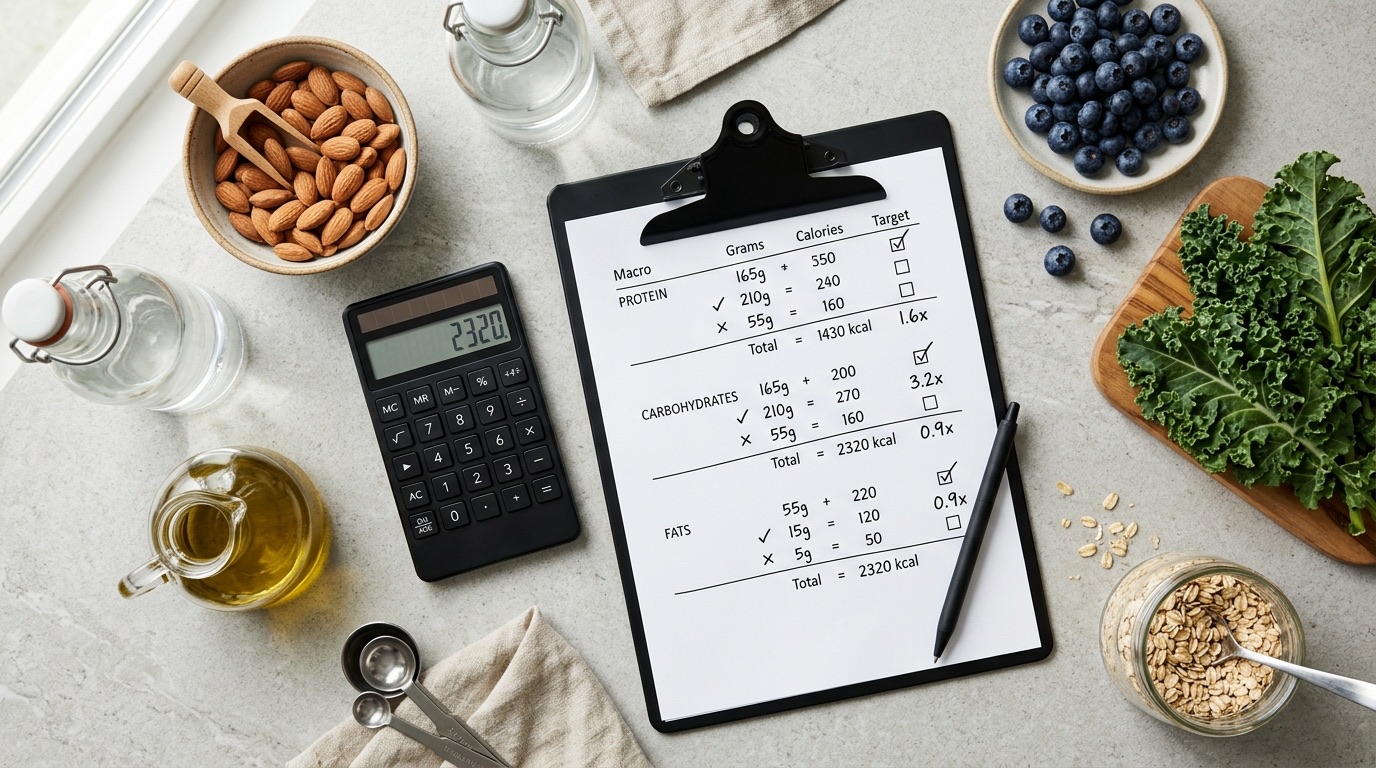
Worked example
Client: female, 30 years old, 70 kg, 165 cm, moderately active (trains 4x/week), goal is fat loss.
BMR (Mifflin-St Jeor, female): (10 × 70) + (6.25 × 165) − (5 × 30) − 161 = 700 + 1031.25 − 150 − 161 = 1,420 kcal
TDEE (moderately active, ×1.55): 1,420 × 1.55 = 2,201 kcal
Calorie target (fat loss, 20% deficit): 2,201 × 0.80 = 1,761 kcal (rounded to 1,760)
Protein (higher end for a cut, 2.0 g/kg): 70 × 2.0 = 140g protein = 560 kcal
Fat (25% of total calories): 1,760 × 0.25 = 440 kcal ÷ 9 = ~49g fat
Carbs (remaining calories): 1,760 − 560 − 440 = 760 kcal ÷ 4 = 190g carbs
Final daily targets: 1,760 kcal — 140g protein / 49g fat / 190g carbs.
That's the starting plan. It's not the plan you leave unchanged for 12 weeks.
Adjust based on real-world feedback, not just the formula
Every equation above is an estimate, not a measurement. Mifflin-St Jeor has a margin of error, activity multipliers are rough by design, and no formula accounts for sleep quality, stress, or how consistently a client actually logs their food.
Treat the calculated numbers as a starting hypothesis and adjust using 2-3 weeks of real trend data:
- Weight and measurements flat when the client should be losing: drop calories by roughly 5-10%, primarily from carbs or fat, keeping protein fixed.
- Weight dropping faster than intended, or the client reports low energy and poor training performance: increase calories slightly rather than pushing through, especially if the rate of loss exceeds about 1% of bodyweight per week for an extended stretch.
- Client not hitting protein consistently: it's often more useful to simplify the target (round numbers, fewer food sources) than to keep adjusting the number itself.
The formulas get you to a defensible starting point fast. The coaching happens in how you read the weekly trend and adjust from there.