
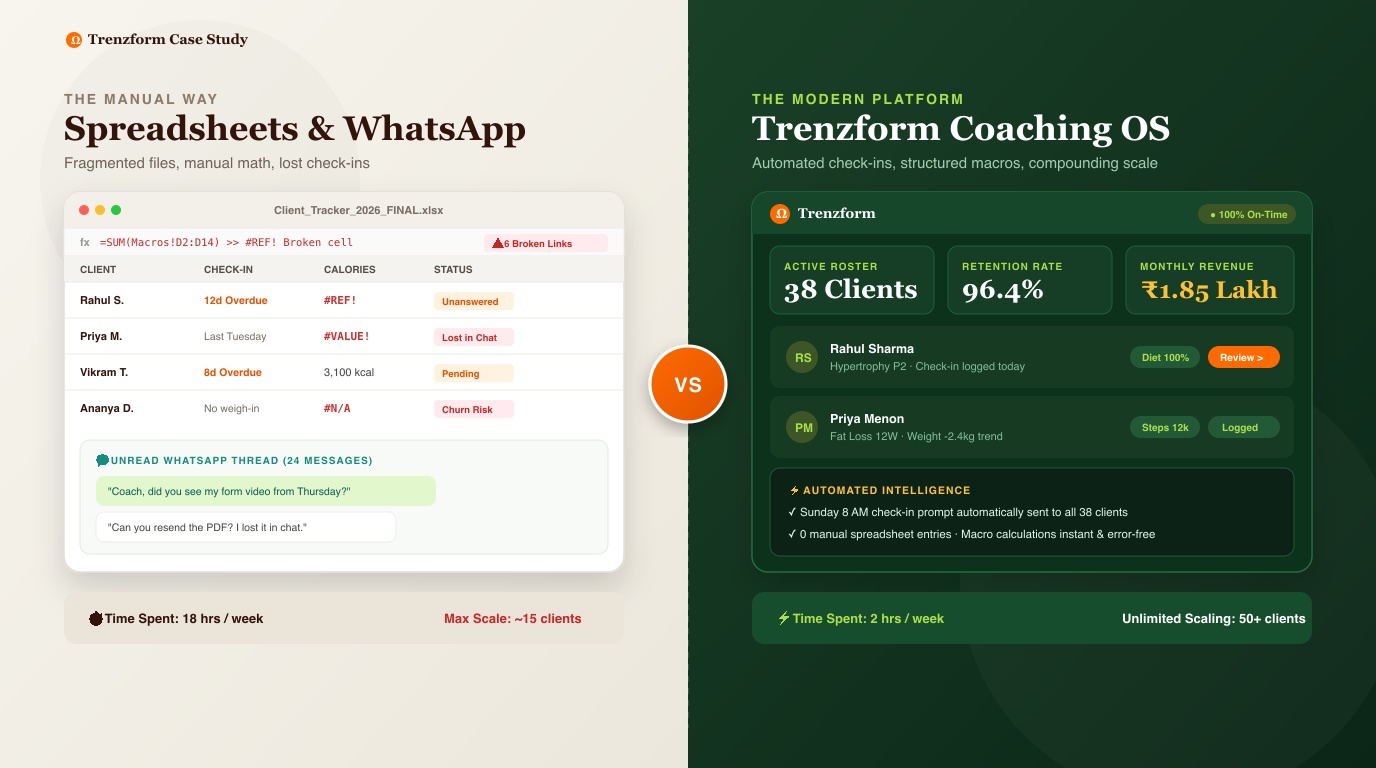
Every coach starts here. You get your first few clients, you build them a nutrition plan in Google Sheets, you track workouts in a shared doc, and check-ins happen over WhatsApp because that's where everyone already is. It works. Then you hit client 12, or 18, or 22, and it stops working — not suddenly, but in a slow accumulation of small failures that you start to just accept as "how coaching is."
Let's put real numbers on what that's costing you.
A realistic scenario: 20 clients on spreadsheets
Take a coach with 20 active clients, each getting a personalized nutrition plan and workout program, with weekly check-ins. Here's roughly where the week goes:
- Building/updating nutrition plans: 20-30 minutes per plan when built from scratch, 10-15 minutes to adjust an existing one. If a third of your clients need adjustments each week, that's 6-7 clients x 12 minutes = roughly 1.5 hours, plus new client onboarding.
- Manual macro/calorie math: Every time a food swap happens, recalculating calories and macros by hand or re-entering into a calculator. Across 20 clients making regular swaps, this alone can run 2-3 hours a week.
- Chasing check-ins: Clients don't check in on their own. You're sending "hey, don't forget your check-in" messages, one by one, in individual WhatsApp threads. Even at 2 minutes per client per week, that's 40 minutes just in reminder messages, before you've reviewed a single response.
- Reviewing scattered check-in data: Photos in one chat, weight in a spreadsheet cell, notes in a voice memo you have to replay. Piecing together one client's week across three mediums takes 10-15 minutes per client. Across 20 clients, that's 3-5 hours.
- Progress tracking: Manually charting weight trends or lift progression, when you bother to do it at all, adds another hour or two if you're being thorough. Most coaches on spreadsheets simply skip this because there's no time left.
Add it up and you're looking at 8-12 hours a week of pure admin for a 20-client roster — nearly a full working day, before you've done any actual coaching (writing new programs, adjusting based on feedback, having strategy conversations with clients). That's time you're not spending on the two things that actually grow a coaching business: coaching quality and sales.
The costs that don't show up as hours
Time is the visible cost. These are the ones that quietly cost you clients and revenue.
Ghosting because there's no structure
When a check-in is "just message me on Sunday," it's easy for a client to let it slide once, then twice, then stop entirely. There's no system prompting them, no visible streak they're protecting, no gentle automated nudge. By the time you notice a client has gone quiet for two weeks, the relationship is already cooling, and re-engaging a client who's disengaged is far harder than not letting them disengage in the first place.
No macro or calorie automation
Manually calculating calories and macros for every food swap isn't just slow, it's error-prone. A miscalculated plan that's off by 300-400 calories either stalls a client's progress or accelerates it in the wrong direction. Either way, it's your name on the plan when the client stops seeing results.
No progress tracking over time
Without automatic charting of weight, measurements, or lift numbers, you're relying on memory or manual notes to tell whether a client is actually trending in the right direction over 8 or 12 weeks. This matters most when a client is unhappy and asking "is this even working?" — a chart answers that question in five seconds; scrolling back through six weeks of chat history does not.
An unprofessional client experience
Clients paying ₹5,000-15,000/month for coaching are increasingly comparing that experience to a subscription app: something that feels designed, not improvised. A client asked to fill in a spreadsheet cell or send progress photos into a group chat with four other clients (a mistake that happens more than coaches admit) reads as amateur, regardless of how good your programming actually is. Perceived professionalism affects both retention and referrals.
Breaking down past 15-20 clients
Spreadsheets and WhatsApp aren't built for scale, and the failure mode isn't graceful. It's forgotten check-ins, duplicated files, wrong plans sent to the wrong client, and a growing sense that you're one bad week away from dropping a ball that costs you a client. Coaches routinely describe hitting a wall around 15-20 clients where the admin load becomes the actual constraint on growing the business, not their coaching capacity or their marketing.
No async voice or photo logging built for coaching
WhatsApp technically supports voice notes and photos, but it's not built for coaching workflows. There's no way to attach a photo to a specific log entry, no timestamp tied to a workout session, no simple way for a client to log a meal by photo and have it associated with that day's nutrition plan. Everything lives in an undifferentiated chat thread that gets harder to search the longer the relationship runs.
What to look for when you switch
When you're ready to move off spreadsheets, evaluate software against the actual failure points above, not just feature lists:
- Templates that update in place. Building a plan once and adjusting it, rather than rebuilding from scratch, should cut plan-update time to a couple of minutes.
- Automatic macro/calorie calculation. Food swaps should recalculate nutrition totals instantly, with zero manual math.
- Built-in check-in reminders. The system should nudge clients automatically, so reminder-chasing isn't manual work you own.
- Progress charts by default. Weight, measurements, and lift numbers should chart themselves as clients log data, not require you to build a graph.
- A dedicated client app, not a repurposed chat tool, so logging feels like part of a coaching product rather than an improvised workaround.
- Room to grow past your current client count without the tool (or your process) breaking down.
What the switch actually looks like in week one
Coaches who've made the move usually describe the same pattern: the first week feels slower, not faster, because you're rebuilding templates you'd already built in spreadsheet form and getting clients set up on a new app. By week two or three, once templates exist and clients have logged a check-in or two on their own, the time savings show up. The check-in reminders alone tend to be the first thing coaches notice, because it's the difference between chasing ten people individually and having the system handle it while you focus on reviewing what actually came in.
The other adjustment is client-side. Clients who've been sending you a WhatsApp voice note for two years will grumble briefly about downloading "another app." That friction is real but short-lived, usually resolved within the first check-in cycle once they notice logging a meal takes fifteen seconds instead of typing out a paragraph. Framing the switch to clients as "this is going to make it easier for you to log things and easier for me to catch problems early" tends to land better than treating it as a system update they need to tolerate.
Where this leaves you
The honest math is that admin time on spreadsheets scales roughly linearly with client count, while the revenue per client doesn't increase to compensate. At some point, every hour you spend recalculating macros or chasing a check-in is an hour you're not spending on the parts of the business that actually make more money: better coaching, more capacity for new clients, or just getting your evenings back.
Trenzform is built around exactly the failure points above: templated nutrition plans with automatic macro calculation, automated check-in scheduling and reminders, progress tracking that charts itself, and free client apps for logging meals and workouts async. For a coach feeling the 20-client wall, it's worth trying during a free trial against your actual current roster, not a demo account, to see where the hours actually go.